Tuesday, June 17, 2014

1001 Movies You Must See Before You Die- Casablanca


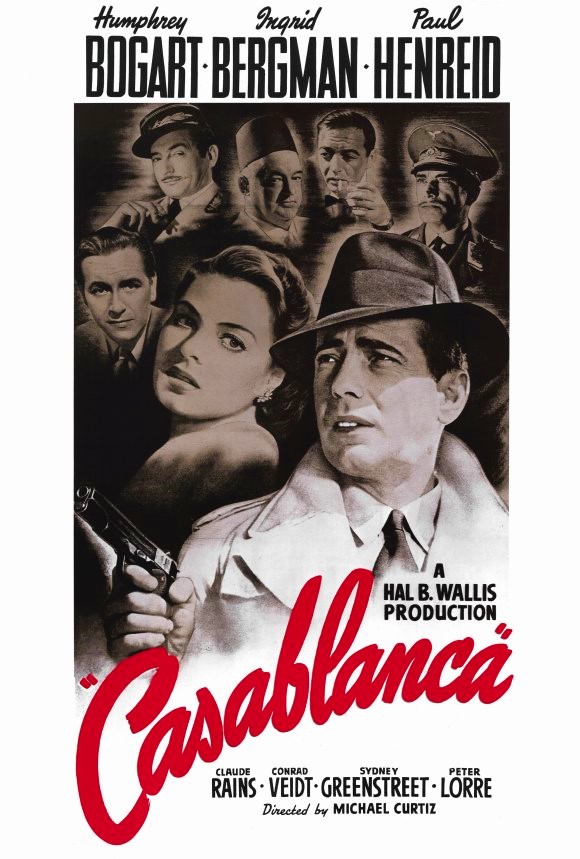
http://upload.wikimedia.org/wikipedia/commons/b/b3/CasablancaPoster-Gold.jpg#165- Casablanca (1942)
Starring: Humphrey Bogart, Ingrid Bergman, Paul Henreid
Directed by: Michael Curtiz


Plot Summary: Rick Blaine is the owner of an upscale nightclub in Casablanca that attracts guests in the form of refugees trying to get to the United States and those who are tracking them down. Rick claims to be neutral in the situation, but in reality, he has fought on the side of the Loyalists against the Nationalists. Rick is in possession of papers that allow free travel and are very valuable to the refugees stuck in Casablanca. Ilsa Lund, Rick's former lover, enters his establishment with her husband Victor Laszlo, seeking Rick's help to get out of Casablanca and into the United States with the "letters of transit" that he possesses. Without revealing his past with Ilsa to Victor, Rick refuses to help, leading Ilsa with not many options left but to tell him that she still loves him and the reason why she left him all those years ago.


Casablanca is another one of those movies that you hear about a LOT from film aficionados, and is regarded as one of the great icons of cinema. Thanks to the star power of Humphrey Bogart, I was looking forward to checking this movie out immensely. And while I did enjoy it, I'm not sure if all of it has aged well throughout the decades. I hope no one twists my words, and understand that there is a whole lot to enjoy, but don't walk into it expecting the PERFECT movie.

http://voidagger.files.wordpress.com/2014/03/dooley-wilson-humphrey-bogart-2.jpgHumphrey Bogart stars as the main protagonist, Rick Blaine. Whether it's James Stewart, John Wayne, Clark Gable, or in this case Humphrey Bogart, I always look at the leading men of yesteryear and see what their appeal was with audiences. For Bogart, he plays Rick with a gruff, no-nonsense attitude, but is still able to have a charm in how he talks. Rick is an amazingly quick thinker, both in his actions and in what he says (just listen to some of the comebacks that he has for people, or see the plans that he has made unravel). Many of the film's most iconic moments and quotes come from Rick and that can all be credited to Bogart's legacy as one of cinema's greatest leading men.

The film does have a pretty solid cast of supporting characters, including Paul Henreid as Victor Laszlo, Claude Rains as Captain Louis Renault, Conrad Veidt as Major Heinrich Strasser, and Peter Loree as Signor Ugarte. The biggest "supporting" character though is Ingrid Bergman as Ilsa Lund. I get that she has a captivating look about her, but that does not make a good character. Using logistics, a lot of the conflicts that arise for Rick and Victor are from misunderstanding and miscommunication through Ilsa's actions in the past (they could have avoided the entire conflict had she just explained at the very beginning). Her performance is probably the one that has aged the worst, but that's because women have come into their own as strong and confident characters over the decades. Unfortunately, that also means that the classic love story between Rick and Ilsa suffers in terms of overall storytelling (curse my appreciation for logical storytelling).

http://danhairfield.files.wordpress.com/2012/02/annex-bogart-humphrey-casablanca_16.jpgOne of the most memorable facets within the film is in its definitive atmosphere. The environment created through the use of lighting (particularly shadows), the sets are able to create the right amount of tone for the film's narrative. Picture the scene where Rick says "Of all the gin joints in all the towns in all the world, she walks into mine," or the climactic scene in front of the plane. If either of those scenes had been altered (more lighting in the former, and less fog in the latter), the overall aesthetic of the film would have been changed because tone would have been altered entirely.

Over 70 years have gone by since Casablanca is released, and there is still so much of it to appreciate. It embodies the look and vibe that a classic movie should have, highlighted by the aforementioned use of atmosphere and Bogart's leading man charisma. Even if some aspects of the film (Ilsa) haven't aged in the most graceful of ways, the film is still a powerhouse in the canon of monumental films.


Rating: 4 out of 5 stars

Maybe the expectations were a little high, but some of the gravitas of the film remained stuck in its own time. Still, there are memorable lines, a tremendous amount of atmosphere, and a career defining performance from Humphrey Bogart that makes Casablanca one of the most iconic movies in history, and one that every moviegoer should at least see once.

Comment below to share your thoughts on the movie or to discuss a topic that I left out of my review 

Casablanca and movie images are copyrighted by Warner Bros.

Tuesday, June 10, 2014

1001 Movies You Must See Before You Die- Citizen Kane


http://upload.wikimedia.org/wikipedia/en/c/ce/Citizenkane.jpg#150- Citizen Kane (1941)
Starring: Orson Welles, Joseph Cotten, Dorothy Comingore
Directed by: Orson Welles


Plot Summary: After wealthy newspaper publisher Charles Foster Kane dies, journalist Jerry Thompson wants to discover the significance of Kane's last word: "Rosebud." As he interviews many important people in Kane's life, he learns more about Kane's rise to the top business wise, as well as his struggles within his personal life. Among those interviewed are Kane's second wife, Susan Alexander, his business manager, Mr. Bernstein, his former best friend, Jedediah Leland, his butler, Raymond, and the written memoirs of Walter Parks Thatcher, a banker who became guardian for Kane during his childhood. Through all of their stories, Thompson knows more about Kane than intended, but is still searching in hope for the meaning of "Rosebud."


After over a year of watching movies off this list, have I finally come across the greatest film of all time? For decades that is what the general consensus has been when discussing Citizen Kane. After hearing how great this movie is, one can definitely get an impression that the film will deliver, but I'll be honest, apart from the whole "Rosebud" thing, I had no idea what this film was even about. So there was a lot to be excited about in watching this film for the first time. On one hand, if I enjoyed it, then no harm no foul, and if I didn't enjoy the film, at least I could cross it off my queue of movies to watch.

https://blogger.googleusercontent.com/img/b/R29vZ2xl/AVvXsEjR87aNJELjDpZkoxtEt1U6Y5i8jhSNDZXFneOeBxjVQ0D-wL17gFM7fVIcN_yBOst0PePJ4yJAt34voXUmM8QvGN3_g2RB4YXROUMWZed2R7fVVDcPB-SJIAbbB8hvqIch_-jfD6CCH0cQ/s1600/Citizen+Kane+9.jpgThe man responsible for Citizen Kane is Orson Welles, who directed, produced, co-wrote, and starred as Charles Foster Kane. As far as visionary standpoint is concerned, we will cover that later, but let's look at his acting portrayal. Welles plays Kane with two distinct personalities. There is a confident, yet brash, business tycoon that is full of charisma and charm, but also a cynical, despicable and greedy man in his personal affairs. That's pretty impressive for his first film role, but that's only a small portion of Welles's contribution to the film.

The supporting characters are a bit of a mixed bag, as many are used more to tell Kane's story than anything else. The ones who stuck out the most were Jedediah Leland and Mr. Bernstein, played by Joseph Cotten and Everett Sloane respectively. Both felt really close to Kane in different ways, with Leland feeling close at one point to Kane, and Bernstein always displaying respect for Kane. Also, some credit should be given to the makeup department for the elderly makeup to show the characters that aged over time, while also giving equal credit to the actors for being able to play their characters as both young and old.

https://blogger.googleusercontent.com/img/b/R29vZ2xl/AVvXsEiVvR05dUvBNcYBjeZrgSq7M8u6rPL7ejg6ozKxQ4iEgpjsYSL6tQSpafyJHZHe0TmMLuyxiWlfHKfujT3Ws9WXwjak5xZqXqr7Lv28aUU02WG_GLXYE6ve0u61QoGZnX9yCGuqQlnbYf4/s1600/CitizenKane_008Pyxurz.jpgWelles also had a vision for how the film would be shown, and it is incorporated through the amazing and innovative cinematography by Gregg Toland. Toland really knows how to incorporate elaborate camera shots and mixing them with proper lighting effects to bring focus on what Welles wants focus to be given to. Each scene has its own unique shots, from Kane's mustached mouth saying "Rosebud," to Kane standing in a room full of mirrored walls, to dark lit rooms with the right amount of light shining in, the visual aspect of storytelling is definitely a highlight of the film that has since changed the way filmmaking and cinematography are done.

Like I said earlier, Citizen Kane has left a lasting legacy on film that has since labelled it as one of the greatest, if not the greatest movie of all time. While I can't go that far in terms of labels, I will say that it has many elements to it that any fan of movies can appreciate. It is a well-constructed film that has great acting, camera, lighting and effect techniques, and a plot that celebrates the good and bad moments of its central character. If that's not a film that movie buffs can study and analyze, I don't know what is then.


Rating: 4.5 out of 5 stars

Maybe it's out of pure film appreciation, but I would definitely recommend that everyone sees Citizen Kane at least once before they die. If anything, it is to observe one of the 20th century's most influential films courtesy of Orson Welles.

Comment below to share your thoughts on the movie or to discuss a topic that I left out of my review 

Citizen Kane and movie images are copyrighted by Warner Bros.

Tuesday, June 3, 2014

1001 Movies You Must See Before You Die- Mr. Smith Goes to Washington


http://upload.wikimedia.org/wikipedia/en/c/ce/Smith_goes.jpg
#129- Mr. Smith Goes to Washington (1939)
Starring: Jean Arthur, James Stewart, Claude Rains
Directed by: Frank Capra


Plot Summary: After the untimely passing of U.S. Senator Sam Foley, the search is on to find his replacement, leading to the selection of a younger candidate, Jefferson Smith, who the government believes will be easy to manipulate through his naivety. Smith is taken under the wing of Senator Joseph Paine and his new secretary Clarissa Saunders, who attempt to bring some credibility back to his name after the newspapers label him a buffoon. Smith proposes a bill to authorize a loan to buy land for a national boys' camp, but the land is already part of a graft scheme that is supported by Paine. While Paine does try to stand by Smith, he is reminded of what would happen to his power and influence in politics if he were to back out. Paine stands aside as the political machine accuses Smith of trying to gain profit through his bill. In order to prove his innocence, Smith must launch a filibuster and convince the U.S. Senate and his constituents to set things right.


When it comes to the year 1939, there are three movies that most people think about. The Wizard of Oz and Gone with the Wind are two of the more recognizable choices with general audiences, but many movie buffs will also think about Mr. Smith Goes to Washington, and regard it as one of the greatest movies of all time. This is one of the more intriguing films I put in my wishlist because I knew plenty of references from American Government classes I had in high school and college, and I had seen an episode of The Simpsons that pays homage to the film. Add the fact that it's made by the director of It's a Wonderful Life and stars one of my favorite actors, James Stewart, and you have some pretty high expectations for this film.

https://blogger.googleusercontent.com/img/b/R29vZ2xl/AVvXsEgBXKMY-dV2YxOyZ1aE9cGJcZ0zteoCnvXhc2P_vCK2Eb6dAggszdY6TultcwfkezICO_9aRYtbDbMJyT-HYXXvuSGL4VhHbO7Jd7gQovrJ93bogHS5813jmiOKPZC5GRGr2cXMluRFVwhf/s1600/Mr-Smith-Goes-To-Washington-14.jpgJames Stewart stars as Senator Jefferson Smith. Stewart continues to display why he is one of my favorite actors of all time, as he is able to give Smith a visible sense of hope and optimism while he's in Washington D.C. His humble nature really paints him as one of the ultimate "good guys" to have in politics, and his speech at the end of the film was powerful enough to cement Stewart as one of Hollywood's biggest powerhouse actors. The film has a very slow build to its climax, but once Smith is able to have the floor for discussion, Stewart is able to show why he's got some of the greatest acting chops of all time by showing as much emotion as possible. One of my favorite themes about Smith is that he is an honest man (which many politicians hate him for) and can tell when others are lying (he's almost like an X-Men).

One of Jefferson's biggest support systems throughout the film is Clarissa Saunders, played by Jean Arthur. Arthur's performance is one of the few that hasn't aged the greatest, and I think a lot of that has to do with her voice. I'm not sure if her voice was considered "seductive" at the time, but nowadays it is definitely ranging more on annoying than anything else. She is credited as being very crafty in the world of politics, which does allow her to stick out as someone superior to Smith in certain areas, so she is able to hold her own against the men in Washington D.C.

Claude Rains plays Senator Joseph Paine, a character who tries to help Jefferson out of respect for Smith's late father (a friend of Senator Paine), but eventually partakes in selling Smith under the bus with the rest of the politicians. The rest of the political figures in the film have a despicable, "holier than thou" arrogance towards them, but Paine is a bit more complex. We can see early on that he (begrudgingly) is trying to look out for Smith and has him keep to himself for a while in order to protect him. It is only later through the deeply-rooted corruption and power within the political machine that Paine must concede and partake in sabotaging Smith. Rains does a good job in making sure Paine can be empathetic when he needs to be due to his guilt, but also loathsome when his loyalties are put on display before Smith and the audience.

http://thebestpictureproject.files.wordpress.com/2011/07/mrsmith1.jpg
While I will never claim to be an expert on American politics, I can still appreciate the film's atmospheric patriotism. There are many scenes in which Smith is overwhelmed by the beauty and history that is on display in Washington D.C., and the montage of monuments and landmarks should leave all U.S. viewers proud to be Americans. Adding to the theme of patriotism, the film offers a great product of Americana in Jefferson Smith, making him one of the more trustworthy and likeable American characters in film history.


Rating: 4 out of 5 stars

There is something very fascinating about Mr. Smith Goes to Washington, but it takes some time to get to it. Still, there are great acting performances all around and a great story told on-screen, making it a film I recommend everyone should at least see once.

Comment below to share your thoughts on the movie or to discuss a topic that I left out of my review

Mr. Smith Goes to Washington and movie images are copyrighted by Columbia Pictures

Sunday, May 25, 2014

1001 Movies You Must See Before You Die- Gone with the Wind


http://upload.wikimedia.org/wikipedia/commons/2/27/Poster_-_Gone_With_the_Wind_01.jpg#133- Gone with the Wind (1939)
Starring: Clark Gable, Vivien Leigh, Leslie Howard
Directed by: Victor Fleming


Plot Summary: While living at her family's cotton plantation, Tara, in Georgia, Scarlett O'Hara learns that the man she loves, Ashley Wilkes, is to marry his cousin, Melanie Hamilton. As Ashley is called to fight in the civil war, Scarlett consents to marry Melanie's brother Charles, only for him to die of pneumonia and measles while fighting in the war. After a brief time of mourning as a widow, Scarlett takes notice of Rhett Butler, a man who has been admiring her for quite some time. As the war worsens, Scarlett must take care of a pregnant Melanie while Ashley is away at war. With Rhett leaving to fight in the war, Scarlett returns to Tara in shambles, and vows to do anything for her and her family to survive.


It's been a month since my grandmother passed away. She was a very important woman in my life, who raised me and helped make me the man I am today. Everything I have in life I owe to what she taught me, and I thought I would share a tiny portion of the impact she had on me by reviewing a movie that she often cited as her favorite, Gone with the Wind. I was never really interested in seeing this film because I thought I knew what kind it was, a sappy, over the top, romance. But when I actually watched it, I was very surprised with how it differed from my expectations. The romance was far from perfect, and even ranged on abusive and dysfunctional, so I was left wondering what it was about the film that my grandmother loved so much. I think I have found the reason, and I hope this review does it justice and makes her proud.

http://cinescapism.files.wordpress.com/2011/02/imagea2fb.gifVivien Leigh stars as Scarlett O'Hara, a character that I had a real tough time liking throughout the film. The best way I can describe Scarlett is that she is an indecisive, spoiled, gold digger, whose pride gets the better of her throughout the film. While she does have her share of strong moments of character development, they are in spades and get lost in the shuffle when her more selfish attributes come out. It's almost puzzling to imagine Scarlett as a main protagonist, because her behavior is almost more fitting of an over the top villain than anything else, which makes it VERY difficult to actually root for her in the long run.

The man in constant pursuit of Scarlett's affection is Rhett Butler, played by Clark Gable. Gable has so much on-screen charisma that he is able to give Rhett an endearing charm throughout the film, mixed with an excellent amount of sarcasm and dry humor. However, towards the end of the film, Rhett exhibits some surly behavior that the audience can empathize with to an extent. They can understand why he is acting the way he is toward Scarlett, but is not supportive of what he is actually doing. And when their relationship continues to get rocky and the more they lose, the more the audience can sympathize with Rhett, because he is constantly holding on looking for something good to come their way. And on a side note, I know for a fact my grandmother thought Clark Gable was one of the most handsome men she had ever seen on the big screen, and it is certainly easy to see why with the amount of charm he exhibits in this film.

Rhett and Scarlett's dysfunctional relationship can all be attributed to the man that Scarlett really wants to be with, Ashley Wilkes, played by Leslie Howard. Ashley is cowardly and conniving, stringing Scarlett along the entire film with complete disregard towards her, or his wife, Melanie, played by Olivia de Havilland. Melanie is actually a more sympathetic character than Scarlett is in all of this because Melanie is genuine and has a deep love for her husband and a deep admiration for Scarlett as one of her closest friends.

One of the more talked about aspects of the film is its depiction of African Americans as slaves. I know that I've made the case in my review of Django Unchained, and touched base a little in my review of The Jazz Singer, but I don't think there is a reason to get upset over "racially insensitive" characters on a historical point of view. I actually really liked Mammy, played by Hattie McDaniel, and thought she was a fun, memorable character of the film. The filmmakers did not make the characters stereotypes to be offensive, but to depict the role slaves had at that time in history.

http://theartofmakingart.files.wordpress.com/2013/03/rhett-butler-scarlett-o-hara-gone-with-the-wind-scarlett-ohara-and-rhett-butler-6967608-1595-1137.jpg
I think Gone with the Wind was my grandmother's favorite film because of its lavish scale. Released at an early point in film history, the film was able to captivate audiences with its use of massive sets and accentuated the color scale in the film by utilizing Technicolor. Everything is able to burst off the screen and it is really easy to get lost in the atmosphere, and perhaps that was what my grandmother loved so much about the film: that it was a visual spectacle and the viewer felt embraced by its vibrant scenery, like they were inside a beautiful portrait. And that's what this film is, a work of art.


Rating: 4.5 out of 5 stars

This is the definition of a classic film. Gone with the Wind is one of those movies that will live in immortality amongst the most celebrated films of all time, and is a film that is worth recommending to all moviegoers to see once, and even worth owning in your DVD collection.

Comment below to share your thoughts on the movie or to discuss a topic that I left out of my review

Gone with the Wind and movie images are copyrighted by Metro-Goldwyn-Mayer

Tuesday, May 20, 2014

1001 Movies You Must See Before You Die- The Jazz Singer


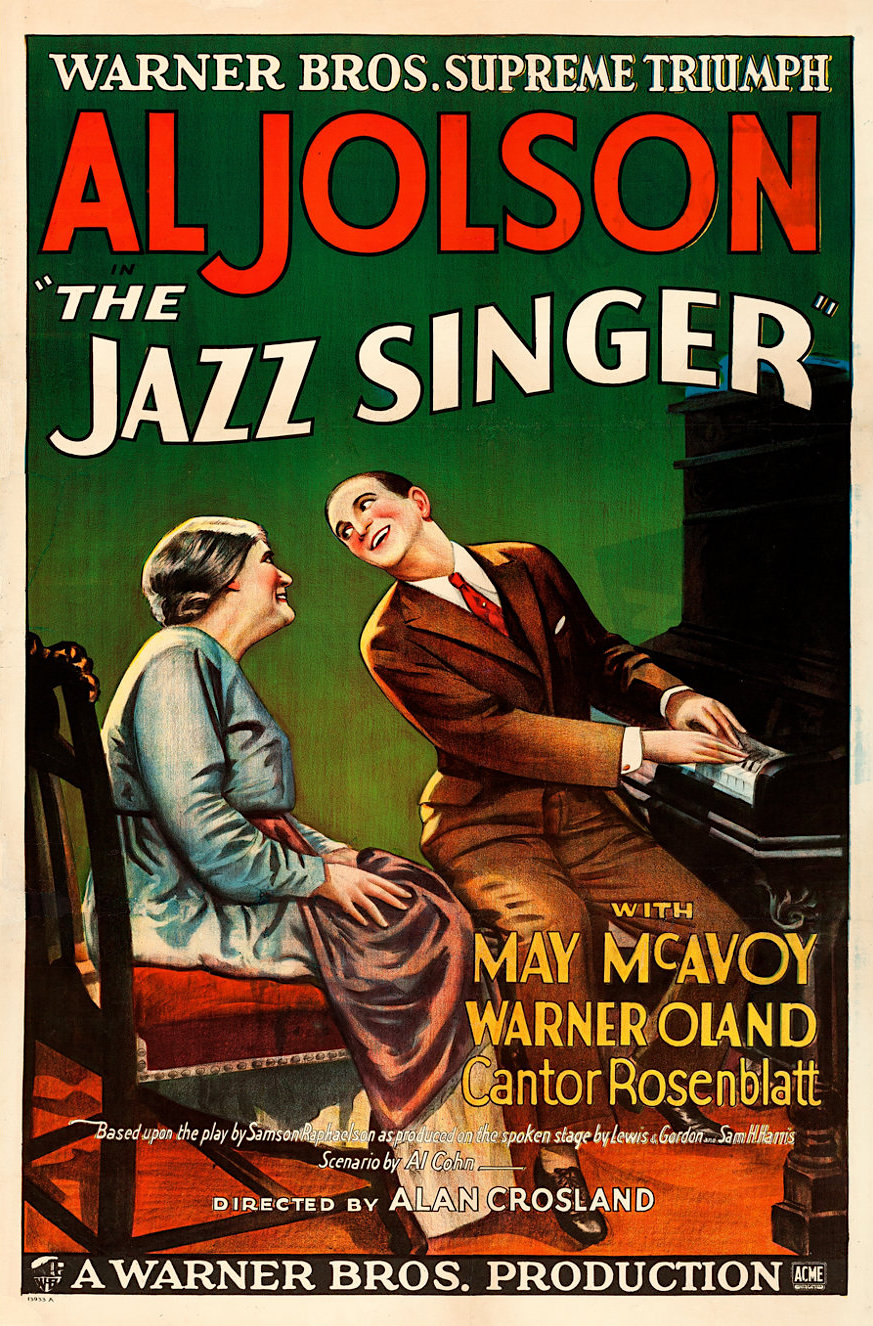
http://upload.wikimedia.org/wikipedia/commons/d/d2/The_Jazz_Singer_1927_Poster.jpg#38- The Jazz Singer (1927)
Starring: Al Jolson, May McAvoy, Warner Oland
Directed by: Alan Crosland


Plot Summary: As a child, Jakie Rabinowitz has a passion for being a jazz singer, a passion that his father strongly disapproves of. With five generations of Cantors in the family, Jakie is given a whipping by his father to convince him to give up singing. Jakie then runs away from home, vowing never to return. Ten years later, Jakie has become a professional jazz singer, under the name Jack Robin. After being introduced to Mary Dale, Jakie is given his big break as the lead in a new musical, April Follies. At the same time, Jakie's father becomes ill and it is now up to Jakie to decide which is more important: the show, or his family and faith.


Before beginning the actual review, I would like to take a moment to apologize for a large gap of time between this review and my last one. These past few weeks have been very hectic in finishing the school year, moving into my summer housing, and looking for a summer job. I'll be spending the next few weeks trying to get back on the reviewing schedule I had originally planned for the summer. Keeping up with the theme of film history, The Jazz Singer is one of the most important films in history for its innovative use of sound at a time when all films were silent.

http://upload.wikimedia.org/wikipedia/commons/5/5c/JazzSingerJackMother.jpgThe film stars Al Jolson as the main character, Jakie Rabinowitz. Jolson adds a lot of flavor to the character, and has enough bravado and charisma to charm audiences with his performance. The layers of Jakie as a character has to do with his motivations (his love of music and expressing himself) and the relationships he has with a handful of good supporting characters.

Jakie's main love interest is Mary Dale, played by May McAvoy, who is a strong enough character that supports and loves Jakie, and serves as a bridge between Jakie and his struggles with his family that plagued him since childhood. Cantor Rabinowitz, played by Warner Oland, is a no-nonsense father-type character who disapproves of his son's love of music because of his loyalties to upholding family tradition (five generations of Cantors in the family broken by his son's pursuit of being a jazz singer). But the best relationship in the film is between Jakie and his mother, played by Eugenie Besserer. She tries her hardest to maintain the relationship between Jakie and his father, and is really Jakie's main motivation in trying to make amends. Jakie loves his mother to the point where the film's final scene involves him singing the song "My Mammy" in front of her and a live crowd.

http://upload.wikimedia.org/wikipedia/commons/5/51/Al_Jolson_Jazz_Singer.JPGOne of the most discussed aspects of the film is its (modernly) controversial use of blackface makeup for Jakie to use while he performs under his stage name, Jack Robin. Once the viewer does a little research about the use of blackface at the time, it should at least put a bit of perspective and context to the discussion. While the action itself is a bit confusing, it is not without reason, and that reason is not to be racially insensitive (at least, that's what I think).

While the film is known for its use of sound, it is only used for scenes involving Jakie singing. Of course, the film utilizes sound to emphasize the beauty in Jakie's singing, almost serving as a representation of the sheer power in his voice, that it brought sound to film for the first time ever. It's often said that a little can go a long way, and in the case of The Jazz Singer, it certainly goes a long way in introducing a whole new form of technology in filmmaking.


Rating: 3 out of 5 stars

The Jazz Singer certainly has its spot in film history, but much of the film has not aged well, and despite its use of sound, feels more like a silent film than people would expect. A recommendation for movie buffs as a demonstration of how sound in film has evolved over the decades.

Comment below to share your thoughts on the movie or to discuss a topic that I left out of my review

The Jazz Singer and movie images are copyrighted by Warner Bros.

Saturday, May 10, 2014

1001 Movies You Must See Before You Die- Metropolis


http://upload.wikimedia.org/wikipedia/en/0/06/Metropolisposter.jpg#33- Metropolis (1927)
Starring: Gustav Fröhlich, Brigitte Helm, Alfred Abel
Directed by: Fritz Lang


Plot Summary: In the future, the Master of Metropolis is Joh Fredersen, a wealthy industrialist that rules over the city. His son, Freder, spends his time with the other children of the wealthy, until he sees a young woman named Maria. Determined to find her again, Freder makes his way to the machine rooms and sees the horrors that he had been sheltered from his entire life. Fredersen has been meeting with the inventor Rotwang, who loved a woman named Hel before she left him to marry Fredersen. Rotwang has been working on a robot that he plans to create in Maria's likeness and destroy Freder, as revenge for Hel dying while giving birth to Freder.


I thought it best to start my summer review series by reviewing at least one silent film, and there was only one I was really interested in covering. Since the overall theme is looking at the history of film, it would only make sense to review a film that changed the landscape of motion pictures and serves as one of the most important and innovative films for its genre. The film I'll be covering today is Metropolis, and the impact it had on science fiction. Because there are versions of this film in both English and German, and cuts of the movie that are missing original footage (deemed "lost"), I have decided to review the 2 hour cut in English, for the bare boned foundation of the film.

The film follows a handful of main characters that are pretty harmless within the film's narrative. Gustav Fröhlich plays the main protagonist, Freder, Brigitte Helm plays the object of Freder's affection, Maria, and Alfred Abel plays Freder's father, Joh Fredersen. There's only so many times you can say "they act really well with their faces and gestures," in terms of actors in silent films before it gets old, so that's all I'll say there. There are some intricate relationships between the main characters though, including Freder's love for Maria, and his strained relationship with his father. Joh Fredersen is also an intriguing character, having an imposing sense of power over other characters based on his reputation. But, even if these are the main characters of the film, they aren't the reasons moviegoers would initially want to check out this film. You hear about an innovative science fiction film, and its the environment created that attracts the viewer, not generic film characters that aren't considered to be related to the concepts of science fiction.

http://scene2scene.files.wordpress.com/2013/04/a2.jpgThe most famous and marketable aspect of this film is the robot you see on all the posters and photos of the film, which is actually a robot duplicate of Maria, also played by Brigitte Helm. The actual robotic version of the creation, created by Rotwang, played by Rudolf Klein-Rogge, doesn't spend a whole lot of time on film, but remains a huge influence on film history. The most noticeable is the obvious influence on the design of C-3PO, making the creation one of the most iconic movie images in the science fiction genre. Add to the fact that Helm was actually in the costume for the film's production, a costume that was groundbreaking for detail in 1927, and you have a fascinating mixture of an actor's dedication and making a director's vision a reality through costuming and effects.

One of the most surprising elements of Metropolis is in its attention to props and sets. I'm not sure if it's a mentality I have about the early days of film, but I never expected the sets to be so grand and detailed. Nowadays, sets are easier to make thanks to larger budgets for construction and the use of CGI to create more difficult sets and backgrounds. But in 1927, that wasn't the case, and efforts made to make sure the sets look magnificent are greatly noticed and appreciated, as they played an integral role in making the world within the film look HUGE.

http://scene2scene.files.wordpress.com/2013/04/a6.jpg
I believe the most commonly used phrase to describe Metropolis is to call it a film that was "groundbreaking for its time." For a film released nearly 90 years ago, it was a film far ahead of its time for production value. The film was so innovative that it inspired many filmmakers to create their own adventures in the science fiction genre, including Stanley Kubrik, Steven Spielberg, and George Lucas. That's right, without Metropolis, there would be no Star Wars (digest that for a moment).


Rating: 3.5 out of 5 stars

It's easy to see the influence Metropolis had on film, thanks to its lavish sets and groundbreaking special effects. While some elements haven't aged the greatest, it's still a must watch for all fans of film at least once.

Comment below to share your thoughts on the movie or to discuss a topic that I left out of my review

Metropolis and movie images are copyrighted by UFA and Paramount Pictures

Sunday, May 4, 2014

An Introduction to my Summer Review Series


The last seven months on this blog have been dedicated to themed months revolving around horror, silent, Christmas, Disney, musicals, gangster, and Western films. It's been a truly rewarding experience to channel my writing to have an overarching message for each month. Come September, I will attempt to pick that up again.

With all that said, I must admit that I did have difficulty coming up with four themes for the months during the summer. It occurred to me that it might be best to actually have an overarching theme that develops throughout the ENTIRE summer.

So what kind of concept can be so deep, yet so broad, that it can actually go throughout an entire four month concept while still spanning the decades and seeming like a fresh concept? Then it hit me: Film History. For the summer, I will be sitting through films that have had the biggest pop culture impact on film history throughout the decades. This series of summer reviews will consist of 20 reviews (too much?) starting from the 1920s and going through to 2010s (that's 10 decades, so 2 films per decade).

This summer will offer a more open selection for me in choosing films that are important to watch. I hope this will be a lot of fun and provides a chance to look at the bigger picture when it comes to film: its history.

So coming soon is my first post in my brief history of film during the summer starting with the 1920s...

Also, feel free to comment on the posts and share them with your friends, family, or anyone who appreciates film. Feedback is very appreciative.

Sincerely,

Danny Fowler (a.k.a. The Author)


Copyright 2013 Fowler's Film Blog.